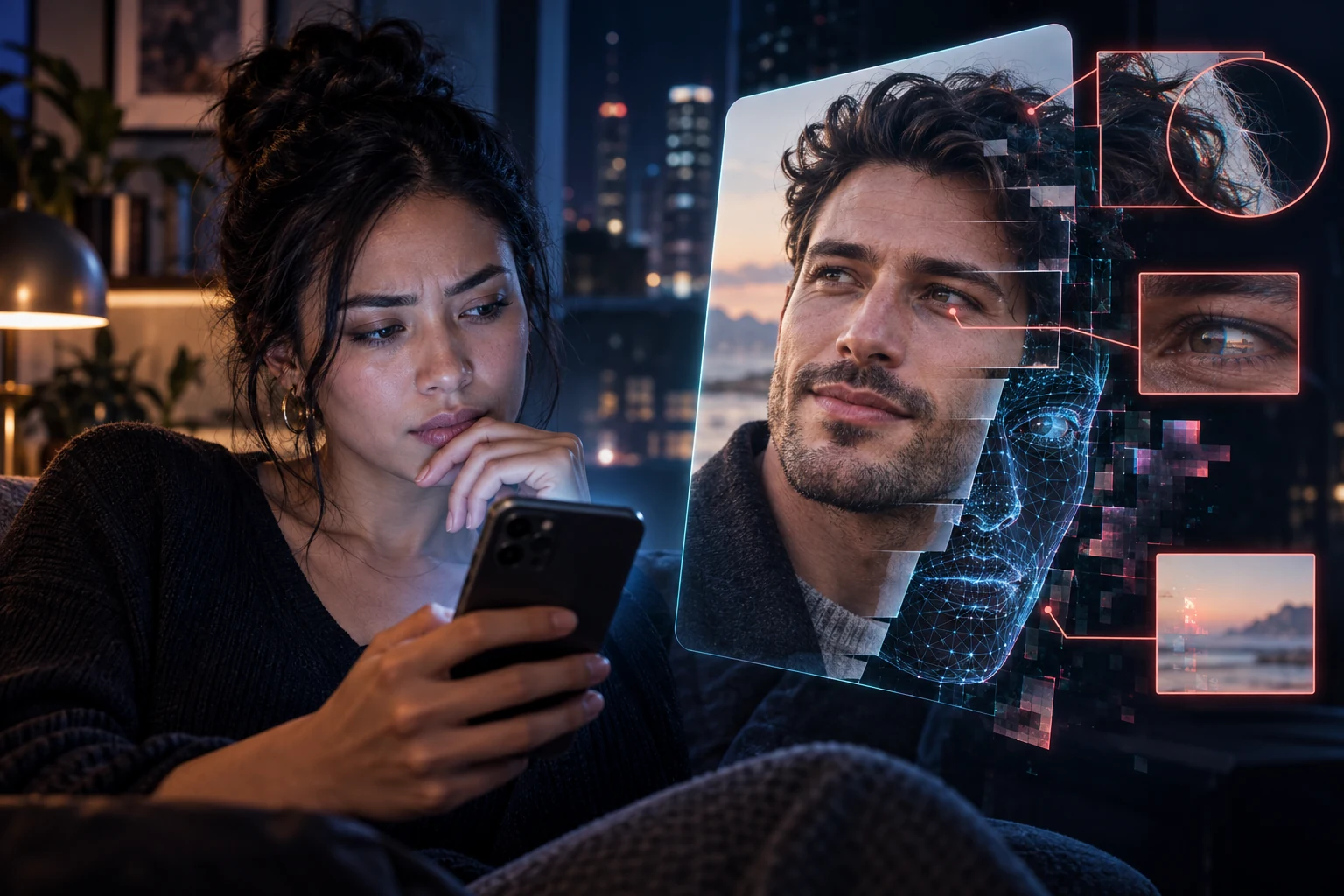
Do not start and finish with the photo. A synthetic face may never have appeared online, so reverse image search can return nothing. Layer three checks instead: inspect physical details, ask for one small unscripted action on camera and judge the person's behaviour. A sudden crisis, crypto tip or investment opportunity is the clearest warning signal.
Click to load the YouTube player. Watch on YouTube ↗
- 01A clean reverse image search is not proof that a profile is genuine.
- 02Real-time face replacement means an ordinary video call is no longer conclusive.
- 03Unscripted movement, changing light and a side profile put the live image under useful pressure.
- 04Perfect availability, rapid intimacy and vague checkable details reveal a broader pattern.
- 05Never send money, cryptocurrency, credentials or account access to an unverified match.
Why this became harder
Fake dating profiles once relied heavily on stolen photographs. A reverse image search could often uncover the original account and end the deception quickly. That check still catches stolen-photo catfishing, but synthetic faces create a different problem: there may be no original image anywhere to discover.
AI-assisted conversations also make it easier for one operator to maintain polished, attentive exchanges with many people. Real-time face replacement can make a profile photo appear to move during a live call. The old instruction to simply request a video call is therefore incomplete.
AI use is not automatically evidence of a scam. A genuine person may enhance a photograph or improve a biography. The risk is a fabricated identity combined with manipulation, isolation or a request for money.
Layer 1: inspect the whole photo set
Single-image mistakes such as incorrect fingers or mismatched earrings have become less dependable. Look for consistency across the entire profile instead.
- Skin without normal textureEvery portrait looks poreless, waxy or heavily airbrushed, regardless of lighting or camera distance.
- Hair that loses its edgeFine strands blur into a shoulder or background instead of ending naturally.
- Background geometry that breaksTiles, bricks, signs, reflections or straight lines warp when viewed closely.
- A photo roll with no ordinary momentsEvery image is flattering and professionally composed, with no candid photograph, bad angle or everyday screenshot.
- No believable historyLinked accounts are new, social connections are thin and there are no tagged moments that predate the dating profile.
None of these clues proves deception alone. The value comes from seeing whether several independent details point in the same direction.
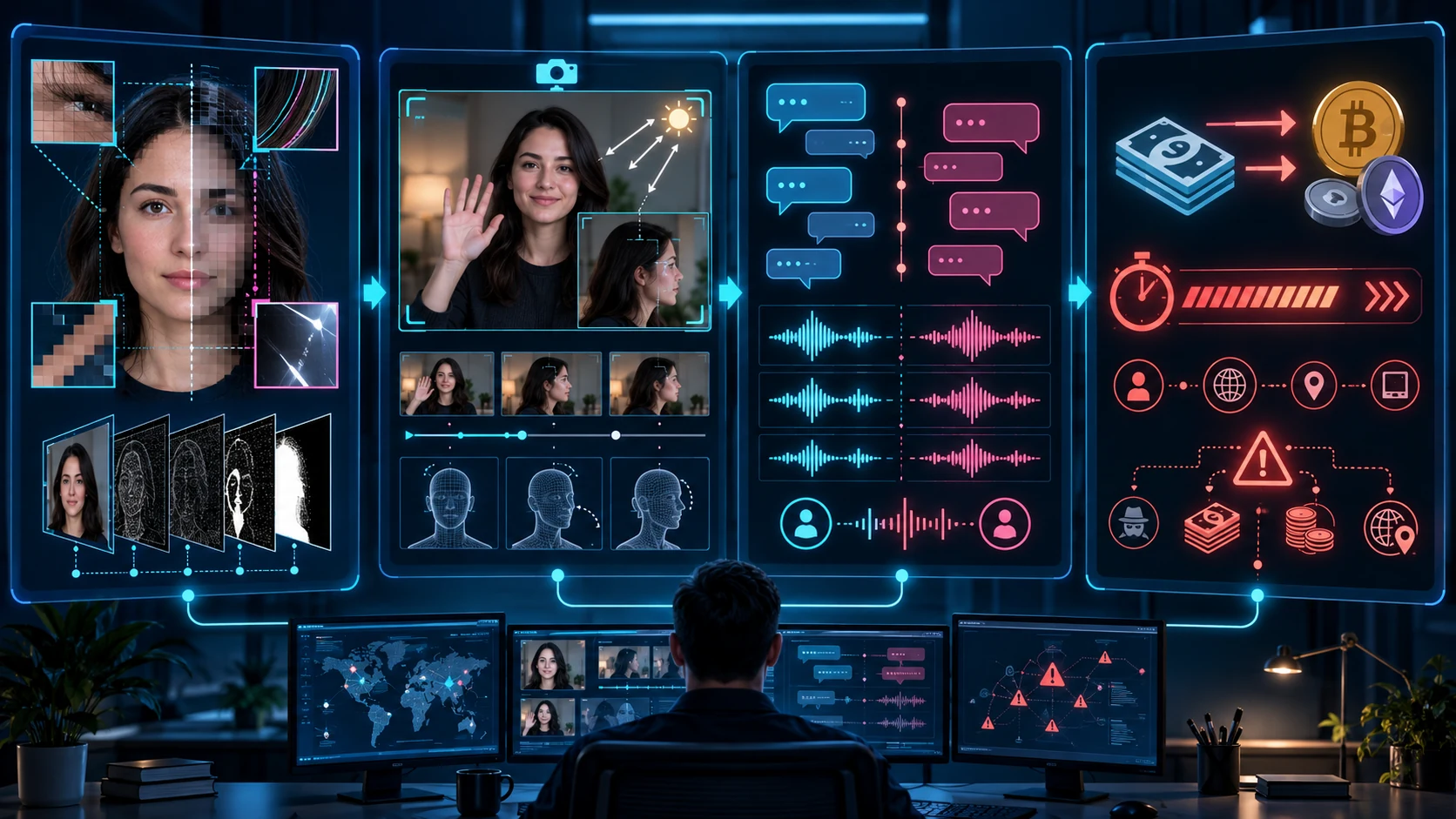
Layer 2: make the video call unscripted
A video call remains useful when it becomes a live test rather than a passive conversation. Keep the request simple and respectful. You are watching for natural movement, lighting and reaction rather than trying to make someone perform.
Watch for smearing, flickering or an unstable edge around the face.
Check whether the lighting changes naturally across the face and surroundings.
Some face overlays distort, detach or lag when the angle moves away from frontal.
A spontaneous hand signal or touch to the ear tests whether the call can react in real time.
Technical glitches happen to real people. The warning pattern is repeated hesitation, unexplained distortion and a refusal to complete any ordinary unscripted check.
Layer 3: read the conversation, not the charm
Behaviour is harder to fake consistently than a portrait. Pay attention to the rhythm of the relationship and whether the story survives ordinary follow-up questions.
- Replies that never missResponses arrive instantly at every hour without natural gaps for sleep, work or daily life.
- Intensity that arrives too earlyDeclarations of destiny, love or a shared future appear before the relationship has faced a single unscripted moment.
- MirroringYour hobbies, phrasing and opinions are reflected back with unusual precision.
- Vagueness around checkable factsThey avoid details about their neighbourhood, weather, workplace or normal day-to-day routine.
- A permanent reason not to meetAn offshore job, overseas deployment, contract or repeated emergency keeps the relationship one screen away.
- The financial pivotA crisis needs money, or a casual conversation becomes a cryptocurrency or investment opportunity.
Score the pattern
This is not a scientific diagnosis. It is a pause button that stops each red flag from being explained away separately. Give one point for every statement that applies.
If you already suspect the profile
- Stop sending value.Do not send money, gift cards, cryptocurrency, credentials or account access, regardless of how convincing the relationship feels.
- Ask for one specific live check.Use a small unscripted action, angle change or lighting change before continuing.
- Run the reverse search anyway.It will not expose a fully synthetic face, but stolen-photo catfishing still exists.
- Treat urgency as evidence.Pressure to move quickly, emotionally or financially, is a manipulation technique.
- Preserve and report.Save the profile, messages, payment information and platform details. Report the account and contact your payment provider quickly if money changed hands.
In the United States, reports can be made through ReportFraud.ftc.gov and the FBI Internet Crime Complaint Center. Elsewhere, contact your national fraud-reporting service and bank.
Practise with nothing real on the line
These games turn identity deception, emotional pressure and suspicious behaviour into decisions you can practise safely.
 PRIMARY PRACTICE
 MESSAGE CHECK
 IDENTITY DEFENCE
Questions people ask
Does reverse image search still work in 2026?+
Yes, but mainly against stolen-photo catfishing. It cannot find an original for a face generated from scratch, so a clean result does not prove that a profile is genuine.
Is using an AI-generated dating photo illegal?+
AI-generated or enhanced imagery is not automatically illegal. The serious concern is using a false identity to obtain money, financial details or access through deception.
Can a video call prove someone is real?+
Not by itself. Real-time face replacement can survive an ordinary call. Ask for a small unscripted movement, a change of angle or a change of lighting and watch how naturally the image responds.
What is pig-butchering?+
It is a long-running relationship scam that builds trust before directing the victim toward a fake investment or cryptocurrency platform. The profile starts the relationship; financial theft is the goal.
What should I do if I already sent money?+
Contact your bank or payment provider immediately, ask whether the transaction can be frozen or reversed, preserve the messages and report the incident to the relevant fraud and law-enforcement services.